Like millions of other Americans, I tend to think of a new year as a fresh start—a time to set goals or resolutions that, when accomplished, will help make me slimmer, healthier, more well-read, a better dog owner, a reliable volunteer in my community, or countless other personal milestones.
But essentially, when I make those resolutions, I’m really simply trying to list ways I can be a better person. And being a better person begins with some fundamentals.
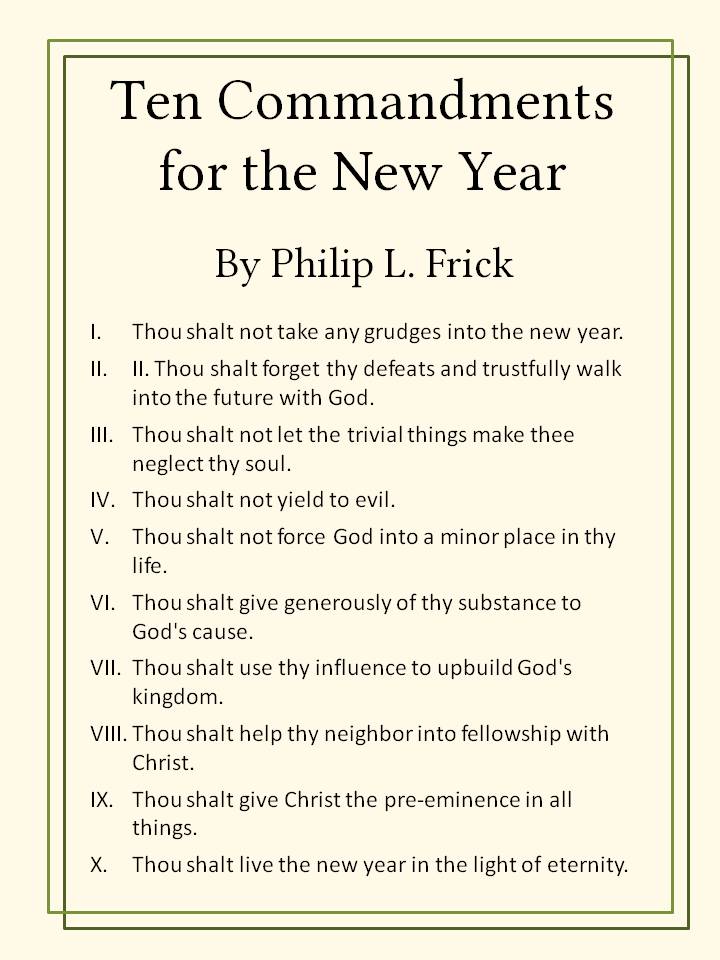
Last week I happened to come across this short piece in an old issue of The Christian Advocate magazine, and it seemed to crystallize all the reasons—and all the outcomes—I’m seeking to accomplish when I make my new year’s resolutions.
While my typical resolutions often focus on the external—my health, my hobbies, or my schedule—Philip L. Frick’s “Ten Commandments” remind me that a truly “fresh start” is an internal journey.
If I really want to improve myself, I need to do more than just check off a list of goals or develop a new habit or two; I need to always keep a higher purpose in mind as the basis for everything I do.
Maybe not all of Mr. Frick’s Ten Commandments will resonate with you, but perhaps at least one or two will speak to your heart as we step into 2026 together.
For me, these simple guidelines are a reminder that the best version of myself isn’t found in a gym membership or a reading challenge—it’s found in the everyday choices I make to put God first and love others well.
Here’s to a year of real transformation, one small step at a time!
In a recent post I mentioned how much I enjoy reading stories and articles in old newspapers and magazines.
Not long ago I was paging through an 1888 issue of The Home magazine and came across an essay titled “Confidence.” I expected to read a lesson on self-assurance and developing a strong character to deal with Life’s adversities.
But that didn’t happen. Not with this article. In fact, this article really surprised me, and I read it about three times to make certain I understood the author’s meaning.
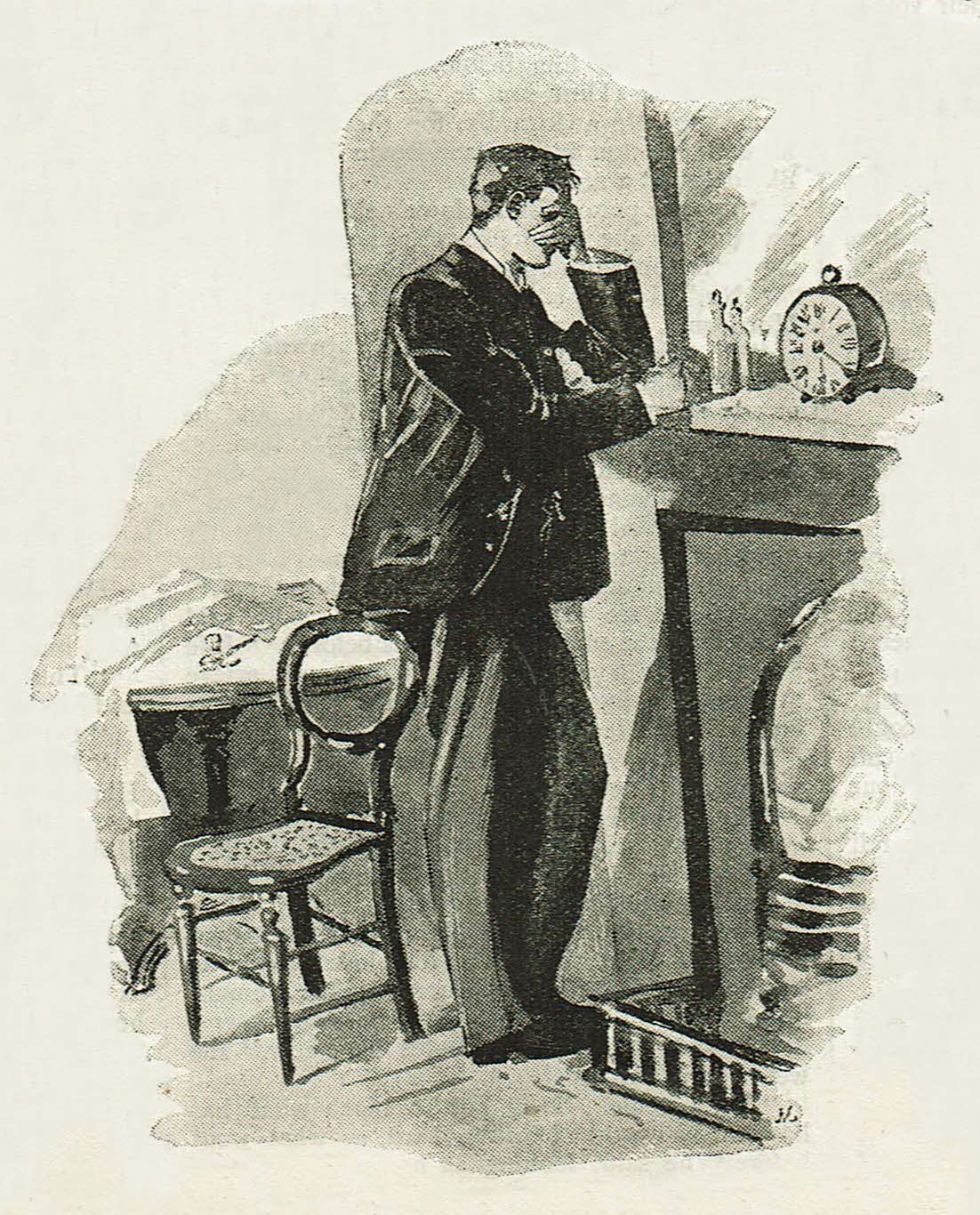
Here’s the essay in full (with a couple of my favorite magazine illustrations to add a bit of visual interest):
The lack of confidence in one another, is a terrible thing to contemplate, for it suggests the unreliability of human nature and the lack of character. The world is so full of villains that men sooner or later are apt to adopt the harsh rule to regard every man as a rascal until he proves himself honest.
It is probably true that every man who has the disposition to help his fellow men is often grossly imposed upon. The imposter and dishonest man are usually accomplished hypocrites, and with smooth words and studied actions are liable to deceive Satan himself.
The honest victim of such wiles is nearly always kind-hearted and unsuspicious, with a firm faith in human nature—notwithstanding its many defects—and while determining after experiencing each new deception, to be more on his guard, is still the prey of the designing, and his own good nature and the evil natures of those who mark him for a victim of their schemes, may at last operate to harden him and drive him into a state of unreasonable uncharitableness.
If there is any gain to anybody from such dishonest practices as lead to such results there might be some excuse for them, considering the weaknesses of men. But it is a fact that nobody gains and that everybody loses. The rascals who plot day and night against their fellow men are not usually profited even in a material sense. They are chronically both poor in purse and character.
The world—so full of enjoyment to honest men—is a source of torture to them. Dishonest themselves, they doubt the honesty of others; guilty, they fear retribution; and dishonorable and vicious, they shrink from the gaze of mankind.
It is a miserable man who fears to meet another. It is wretched existence that neither enjoys the confidence of our fellow men nor gives them our confidence; and while these solemn facts are patent, it is a marvelous thing that the chief purpose of life should not be to build character and win confidence.
Money is not nearly as valuable as character, for money cannot buy the respect of thoughtful men and women, and the most beautiful portions of life’s pathway are like deserts without the respect, love and confidence of mankind.
I wish I knew who wrote this, but, sadly, that information wasn’t printed; I’d like to read more of this author’s writings. His/her thoughts about trust, character, and the human tendency to become cynical after being deceived are insights that feel as relevant now as they must have felt to readers in 1888.
I think it’s remarkable how words written nearly 140 years ago can speak so directly to our lives today.
In our modern world we’re often advised to be cautious and skeptical—to protect ourselves from scammers, fraudsters, and those who would take advantage of our good nature. But this old essay is a timeless reminder about what truly matters. Some things, like honesty, respect, and the value of integrity never go out of style.
I’m always on the lookout for issues of old magazines or newspapers that might contain Isabella Alden stories that I can share on her blog. And if I do find one of her stories, I count myself lucky indeed!
But every once in a while I come across something unexpected—a never-before-published short story or novel by Isabella’s niece, Grace Livingston Hill.
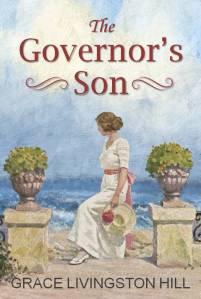
That was the case with The Governor’s Son, a serialized novel Grace wrote for a Christian magazine in 1904.
A few months later, I discovered a short story Grace wrote for the same magazine.
Written with a Thanksgiving theme, Grace wrote “The Kitchen’s Thanksgiving” in 1892, the same year she married her first husband, Frank Hill.
The magazine published the story with some fun illustrations. Here’s a sample:
Samuel was fixed for the evening.
As far as I can tell, “The Kitchen’s Thanksgiving” was never published in book form, either on its own or as part of an anthology.
Finding that story sent me off on another search through yet another series of old magazines to see if I could find more. The result was …
I discovered eight more short stories by Grace Livingston Hill!
.
Since all the stories I found are now in the public domain, I thought it would be a good idea to combine them and publish them together, along with their original illustrations.
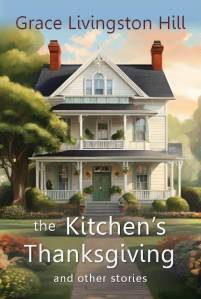
The Kitchen’s Thanksgiving and Other Stories is now available on Amazon! You can click here or on the book cover below to find out more:
.
In the meantime, if you’re looking for some wonderful Christian fiction, I hope you’ll check out the Free Reads page on the Isabella Alden blog. There you’ll find novels and short stories of faith written by Isabella, Grace, Marcia Livingston (Grace’s mother), and Faye Huntington (Isabella’s best friend).
I will admit that I am a little bit of a nostalgia junkie.
I’m especially susceptible to collecting old books. One reason I love them so much is the quality of books that were produced in by-gone times
We live in such a disposable society now days that we forget that there was once a time when books were printed on paper so well milled you could actually feel the texture of the fibers as you ran your fingers across a page. And leading artists of the day were hired to create not just cover art, but chapter headings and story illustrations throughout the book, as well.
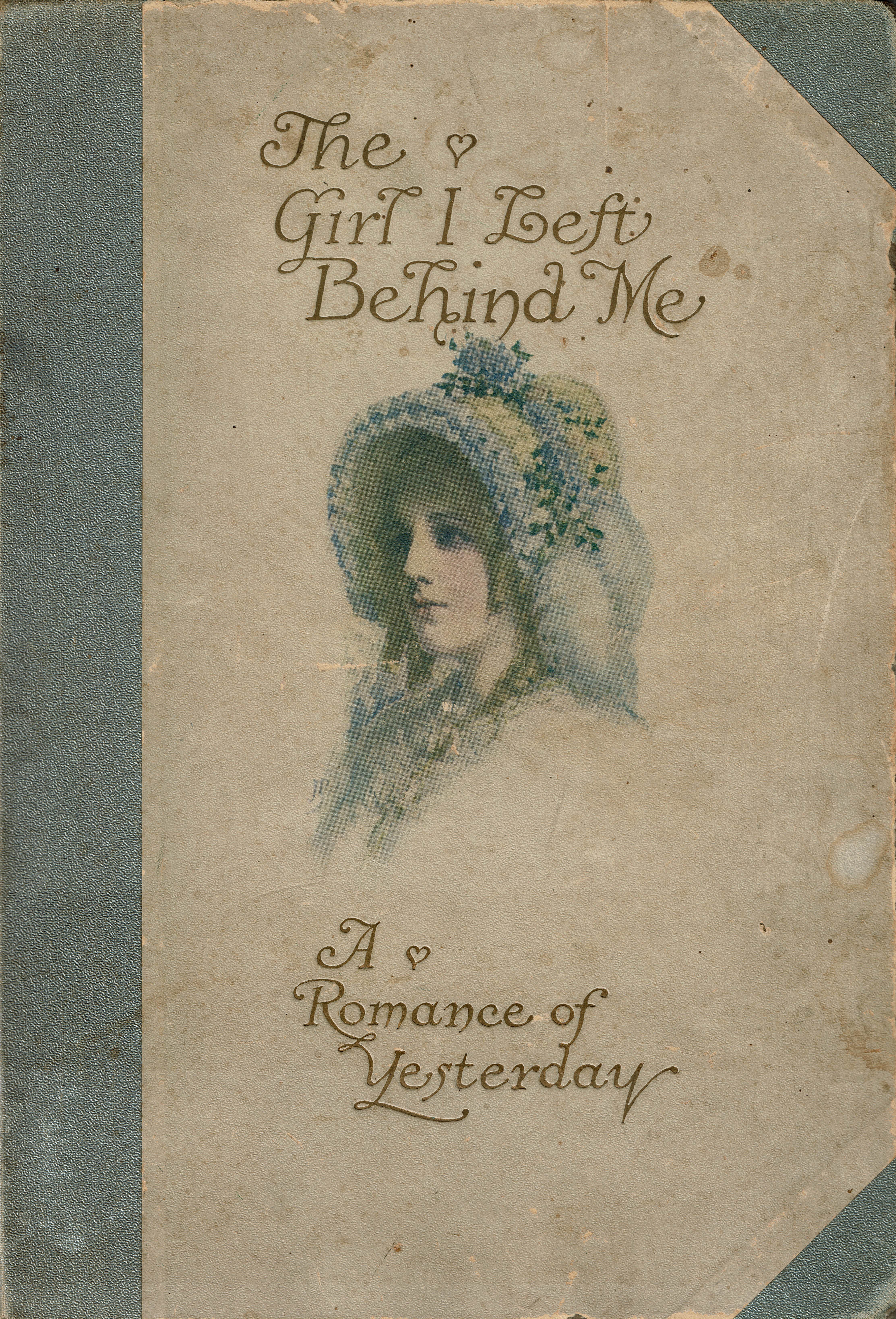
I’ll give you an example of what I mean, and share with you one of my favorite antique books. The Girl I Left Behind Me by Weymer Jay Mills was published in 1910. My copy is not in the best shape; there are some tears on the pages and some foxing, as well. I enjoy it anyway, because it was an unusual book even for its time because it was so beautifully illustrated.
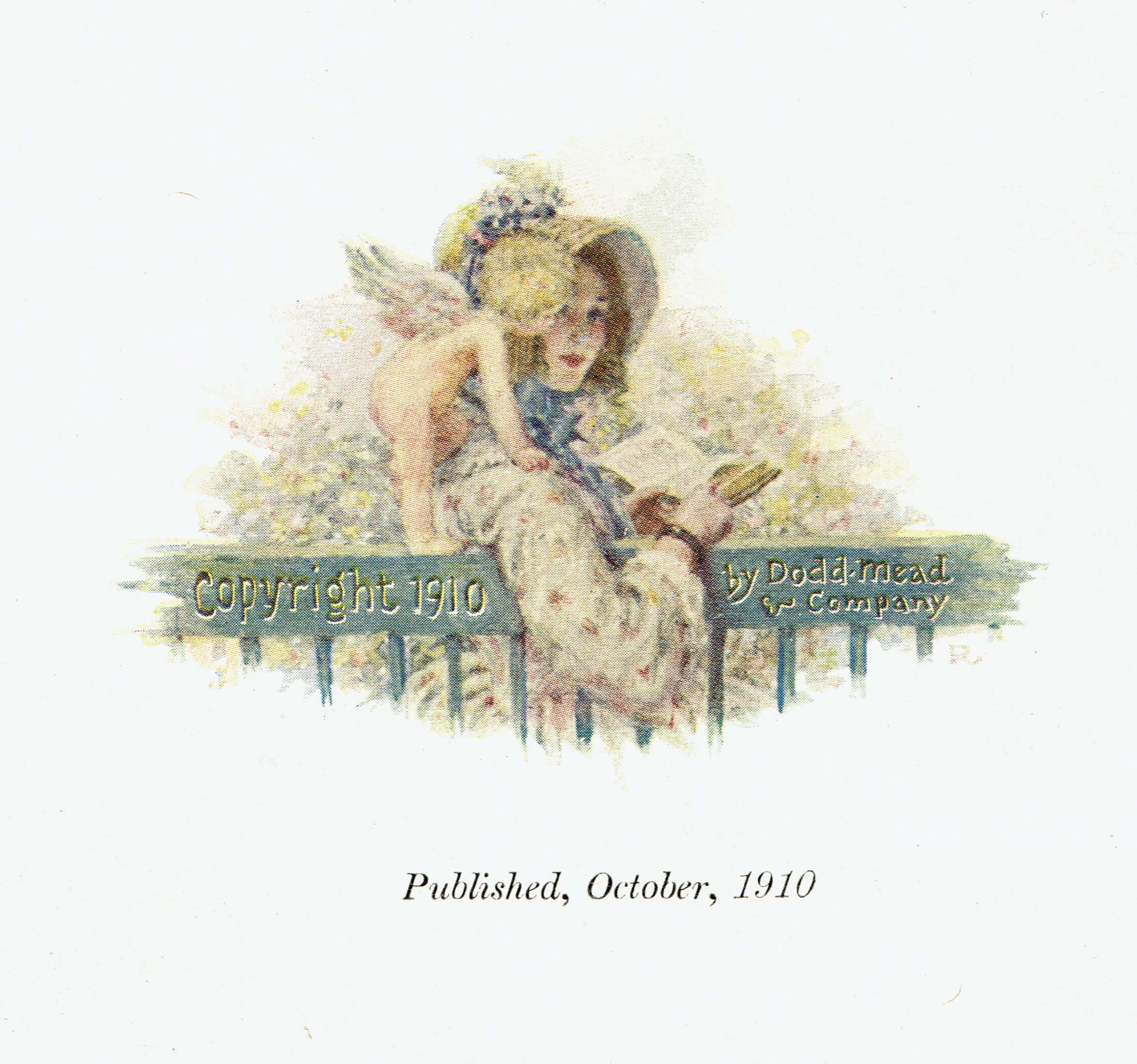
Even the copyright page had its own little piece of artwork by artist John Rae, who had free rein to illustrate and embellish scenes from the novel as well as page and chapter headings.
One reason why this particular book may be more lavishly illustrated than others of its time is the reason it was published in the first place. Here’s a close-up of the book’s dedication page:
I wondered, after I read it, who Mrs. Adolph Ladenburg was, and what she did to excite so much admiration that the publisher and author would produce such a lavishly adorned volume. It only took a little bit of Internet research find out.
A watercolor portrait of Mrs. Ladenburg from the New York Historical Society.
Mrs. Adolph Ladenburg (born Emily Louise Stevens) was a powerhouse of east coast American society from the 1880s until her death in 1937. Her father was a wealthy New York banker; her husband, whom she married at the age of twenty-two, was a wealthy partner in a Wall Street investment firm.
Emily Ladenburg, from a 1902 magazine at the New York Public Library.
Emily was a skilled horsewoman, and is credited with being the first woman who dared to wear a “split skirt” while riding, which allowed her to modestly straddle her horse, instead of riding side-saddle.
She was also a charitable whirlwind, who dedicated much of her time and energy to aiding women and children (she championed one of the first school lunch programs in New York).
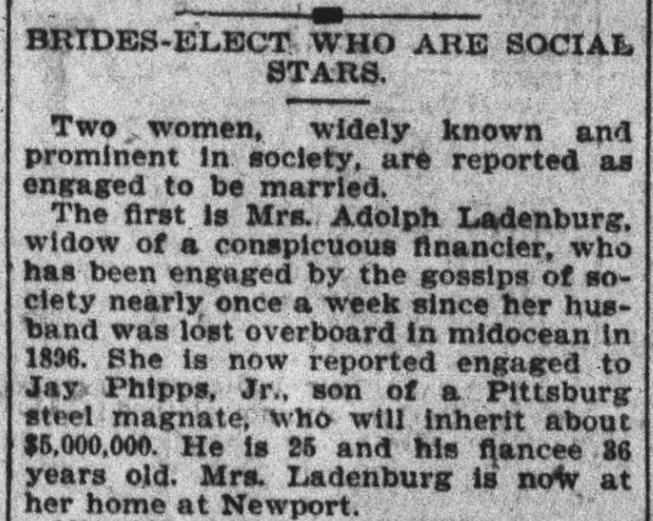
By the age of thirty-one Emily was a widow, and a very wealthy one. She never married again, but she was a frequent subject of romantic speculation in newspapers across the country. Here’s an example from a Virginia newspaper in 1902:
From the Virginia Chronicle, July 16, 1902.
In one three-month period alone her name was romantically linked with three different men; one newspaper asserted she had been engaged to each man for a very short period of time. Whether that’s true or not is still a topic for debate.
How this little book came to be written about Emily is also a mystery. I think it’s possible that at one time her path crossed the author’s path. Weymer Jay Mills was a magazine editor and writer who covered the Vanderbilts, the Whitneys, the Astors, and other prominent members of society. It would not have been difficult for him to come upon Emily Ladenburg during the course of his job.
It’s equally possible that Mr. Mills was just someone who adored Mrs. Ladenburg from afar and hoped that by writing this story, he could somehow attract her attention. Either way, it seems to me that Mr. Mills was quite smitten with Emily Ladenburg.
Just like Helen of Troy, whose beauty launched a thousand ships, Mrs. Ladenburg’s beauty and style launched a lovely little book that has been on my shelf for many years. Mr. Mills’ writing style is fanciful and over-the-top; Mr. Rae’s illustrations are romantic and sweet.
You can click on the cover below to open a PDF of the book so you can read the story and see all of the lovely illustrations the artist created. I hope you enjoy the book as much as I do!
It’s no secret that I’m not technologically savvy.
Websites stump me.
Constantly changing social media platforms are my nemesis.
And I cannot download apps to my phone because my current phone is so old it won’t accept software updates anymore. Despite that, I refuse to replace it because it works just fine for my needs, thank you very much.
It always seems that I struggle when it comes to any device or software, especially the ones that promise to be “user intuitive.”
And that brings me to the topic of my latest struggle with Facebook.
For the last nine years I’ve had a Jenny Berlin Author page on Facebook. I haven’t always posted faithfully, but I’ve certainly done plenty of posts since the page first went live in 2013.
But a couple of months ago I began to receive notices from FB that they were going to delete my Jenny Berlin Author page because it was grey.
I admit I have a touch of grey hair at the temples, but I don’t think my account needs to be deleted because of it. (A little joke. Not a good one, but a little one.) I like my FB page; I want to keep it just as it is.
But I quickly learned you can’t argue with Facebook. There’s no way to protest their decision. And even when I followed the links on their messages to try to remedy the situation, either the links didn’t work or the pop-up screen told me to click on links that didn’t exist.
So I’m stuck.
That means that as of August 31 Facebook will delete my Jenny Berlin Author page, whether I like it or not.
So I took matters into my own hands and resurrected an old Facebook account I set up years ago and rarely used. It’s a personal profile account that I never did much with because I was so busy with other things.
But as of today, that old Facebook profile is alive and well and ready to go! You can find it by clicking here:
If you’re on Facebook, I hope you’ll stop by to say hello!
Last year I set up a new reading nook and created a plan to reduce the number of books I own (you can read about it here).
Progress was slow at first; then I gained a bit of momentum as I went through my old Mills and Boon nurse romances. Every single one of them made it into the “donate” pile.
Next I tackled my collection of Heartsong Presents romances. In the 1990s they were some of the first Christian romances I read, including this early novel by Lauraine Snelling:
Dakota December, a 1996 novel by Lauraine Snelling.
I remember how happy I was to find these books. I think they were among the first romances I found that included an element of faith woven into the story; and the best part was the publisher distributed the books by mail order. Every month four new Heartsong Christian romances magically appeared in my mail box! Woo-hoo!
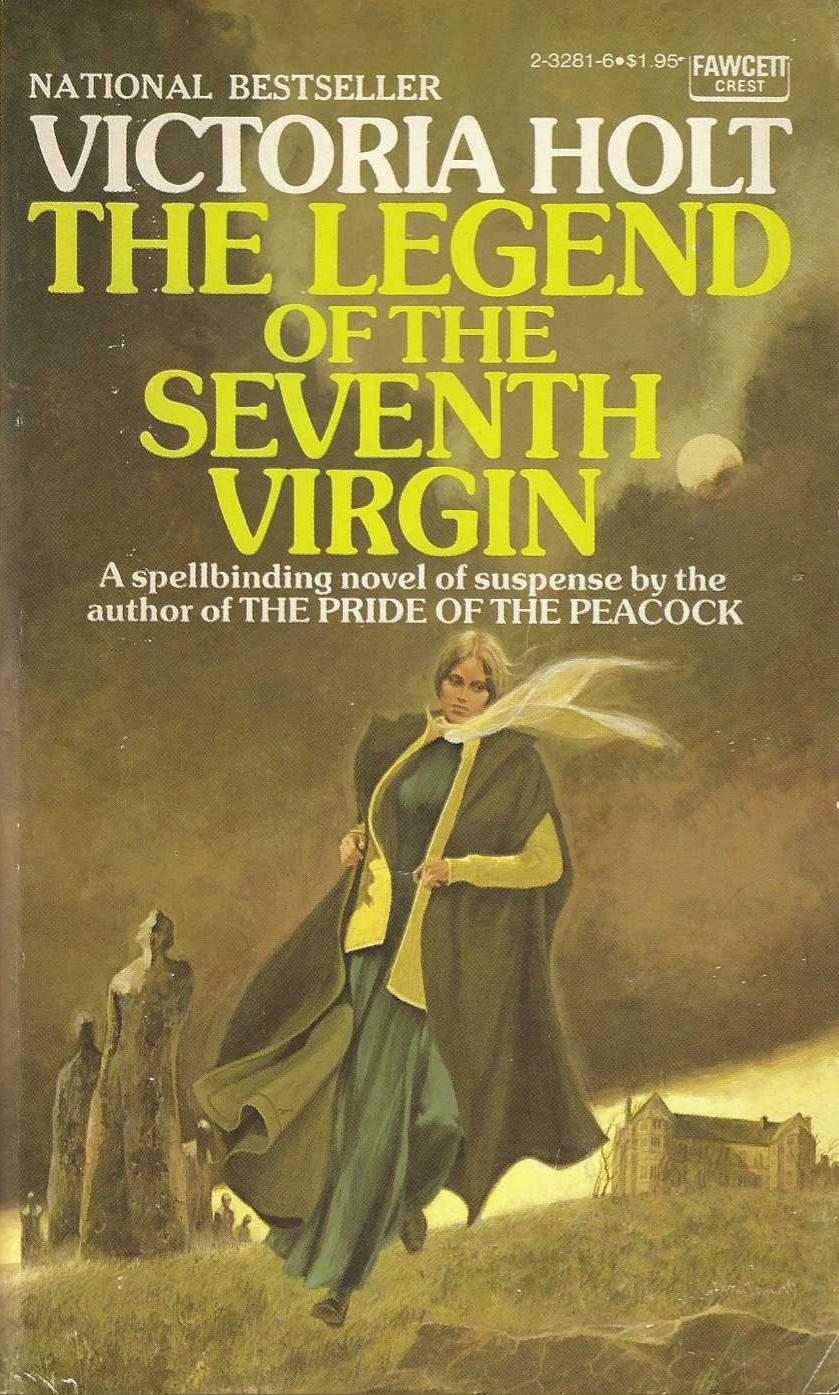
Another genre I read a lot was romantic suspense; and because my older sister bought just about every Victoria Holt gothic adventure novel ever published and passed them along to me, I developed quite a passion for them.
The cover of The Legend of the Seventh Virgin by Victoria Holt.
Each of Holt’s novels followed a pattern: A beautiful/lovely young woman—alone in the world—inherits/takes a job/goes to live in a legend-haunted castle/chateau/mansion.
Cover of The King of the Castle by Victoria Holt.
Soon after her arrival, the heroine either gets curious or inadvertently discovers a long-buried secret, thereby putting herself in danger. Usually that danger involved spooky specters, trap doors, and attempts to murder her in order to keep that dark family secret hidden from her prying eyes.
This epigraph in the front of Holt’s novel The King of the Castle helps set the tone for the spookiness about to ensue:
To me Holt’s heroines were a wonderful blend of Nancy Drew, Jane Eyre, and Lucy Pevensie. They were honest, brave, resourceful, and smart. And no matter what threats or dangers were thrown in their way, they never backed down. In the end, they were rewarded with everything they ever wanted: love and a place to belong.
When I was in my late teens and early twenties I devoured Victoria Holt’s books. Manfreya in the Morning was my favorite and I’ve read it many times over the years.
The cover of Manfreya in the Morning by Victoria Holt
But my spooky castle novel addiction didn’t stop with Victoria Holt. Once I finished reading all of her books, I sampled gothic suspense novels by other authors.
The cover of A Finger to Her Lips by Evelyn Berckman
They were pretty good, too; but for me, Victoria Holt was the queen of romantic suspense.
Over the last few weeks I’ve re-read her wonderful novels. The stories are still great; but reading them also took me back to a time when they provided a much-needed escape from my humdrum world of school and work. And now that I’ve reread them all, I know it’s time to say goodbye to them.
It’s a tough decision to make, but into the donate box they go. Next week I’ll pick another genre of books from my collection to re-read and either donate or re-shelve. I wonder what books I’ll choose?
Is there a book or genre that takes you back and reminds you of “the old days” every time you read it?
My “real job” still takes up a lot of my time, but I’ve managed to make some progress on some of my personal goals:
My sister and I have been writing a new book, and it’s really coming together! Our work-in-progress just passed the 90,000 word mark, which means it’s going to be a real, honest-to-goodness novel one day.
But, as always, what really keeps me busy is the Isabella Alden website. Between writing posts, researching the lives of Isabella and her family, and searching for more of her stories to share, it’s almost another full-time-job!
I think my efforts on the blog are paying off, though, because the number of subscribers and visitors continues to grow daily. Last Friday morning readers from a variety of countries visited the site:
It’s thrilling to know Isabella once again has fans all over the world!
And the best part of that growth is that I still have plenty of her stories to share, as well as bits and facts about her life.
So, I guess that means that I can look forward to having my almost-full-time-job of running the Isabella Alden blog for some time to come.
Is there a topic or story you’d like to see featured on Isabella’s blog? Leave a comment and let me know!
Are you watching the Winter Olympics? I missed the opening ceremony, but I’ve been trying to watch at least part of the coverage of every event category. I’ve watched curling, speed skating, bobsled heats, all kinds of skiing, and even hockey.
By far, the skating events are my favorite. When I was young I became fascinated with ice skating, mostly because I grew up in southern California where snow and winter sports were uncommon. But my mother was a fan of Olympic skater-turned-actress Sonja Henie, who parlayed her three gold medals into a film career. My mom never missed one of Sonja’s movies when they were on TV.
The movie I remember most was “Sun Valley Serenade.” In it Sonja and co-star John Payne (who played Natalie Wood’s optimistic neighbor in “Miracle on 34th Street”) sang, skated and danced their way around an Idaho ski resort. Hi-jinks and romance ensued.
I tried ice skating once when it was about twelve. Unfortunately, I spent more time falling on the ice than gliding across it, so I never tried it again. But like Lady Catherine de Bourgh in Jane Austen’s Pride and Prejudice, I’m pretty certain that:
If I had ever learnt, I should have been a great proficient.
Instead I’m content to watch Olympic ice skating on TV.
Pairs skating are my favorite events. I was mesmerized by USA’s Madison Chock and Evan Bates’ beautiful free skate performance; the same for France’s Gabriella Papdakis and Guillaume Cizeron (who earned a gold medal in the event).
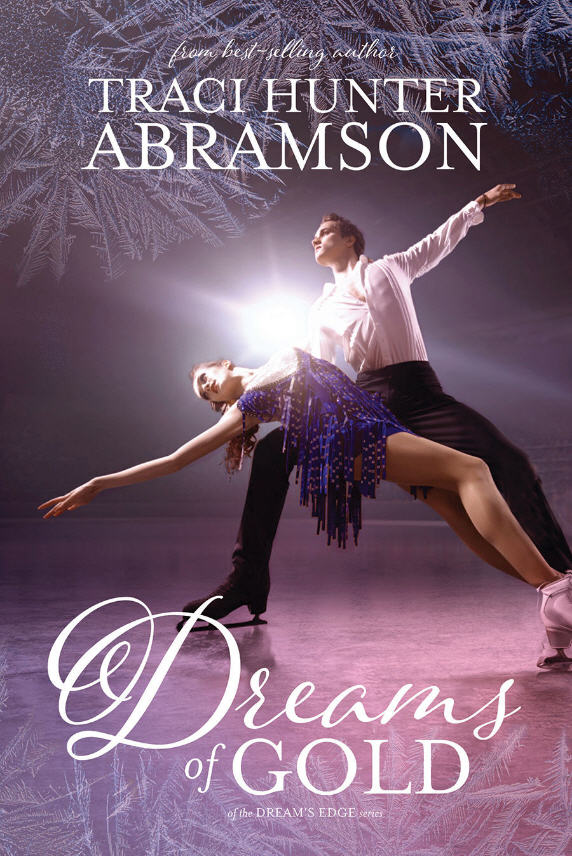
So yesterday, when I was browsing Amazon for a new book to read, this one caught my attention:
Isn’t the cover gorgeous? I’ve never read this author before, but the book has some great reviews. And since I was in an ice skating mood, I didn’t hesitate to tap the “Buy It Now” button. It’s going to be my weekend read as we head toward the Olympics closing ceremony on Sunday.
What do you think? Have you ever been inspired to read a book based on real-life events?
(By the way, I don’t receive any compensation for directing you to Traci Hunter Abramson’s book; I just like to share interesting books I find with others.)
I’m always on the hunt for stories by my favorite Christian authors. By now, you probably know who my top three are:
Isabella Alden (writing as Pansy)
Grace Livingston Hill
Marcia Livingston (writing as Mrs. C. L. Livingston)
I love finding a gem of a story that hasn’t seen the light of day in years, and making it available for others to read.
So you can imagine my excitement when I came across a book for sale that had not one—not two—but three novel-length stories by Isabella Alden!
The seller provided a helpful snapshot of the anthology’s table of contents:
I recognized the title of the first story; TheRandolphs was one of the first Pansy books I ever read; but the other two Pansy titles were brand new to me. So, of course I hit the “buy now” button and claimed that book for my own!
The book arrived yesterday, and I could hardly wait to open it up and begin reading. I snuggled down in my favorite chair and turned to page 65 to read the story titled “A New Craft.”
Imagine my surprise when I saw this instead:
Argh! That’s not a new story, at least, not for me. I’ve had my very own hardback copy of ANewGraftontheFamilyTree on my bookshelf for years.
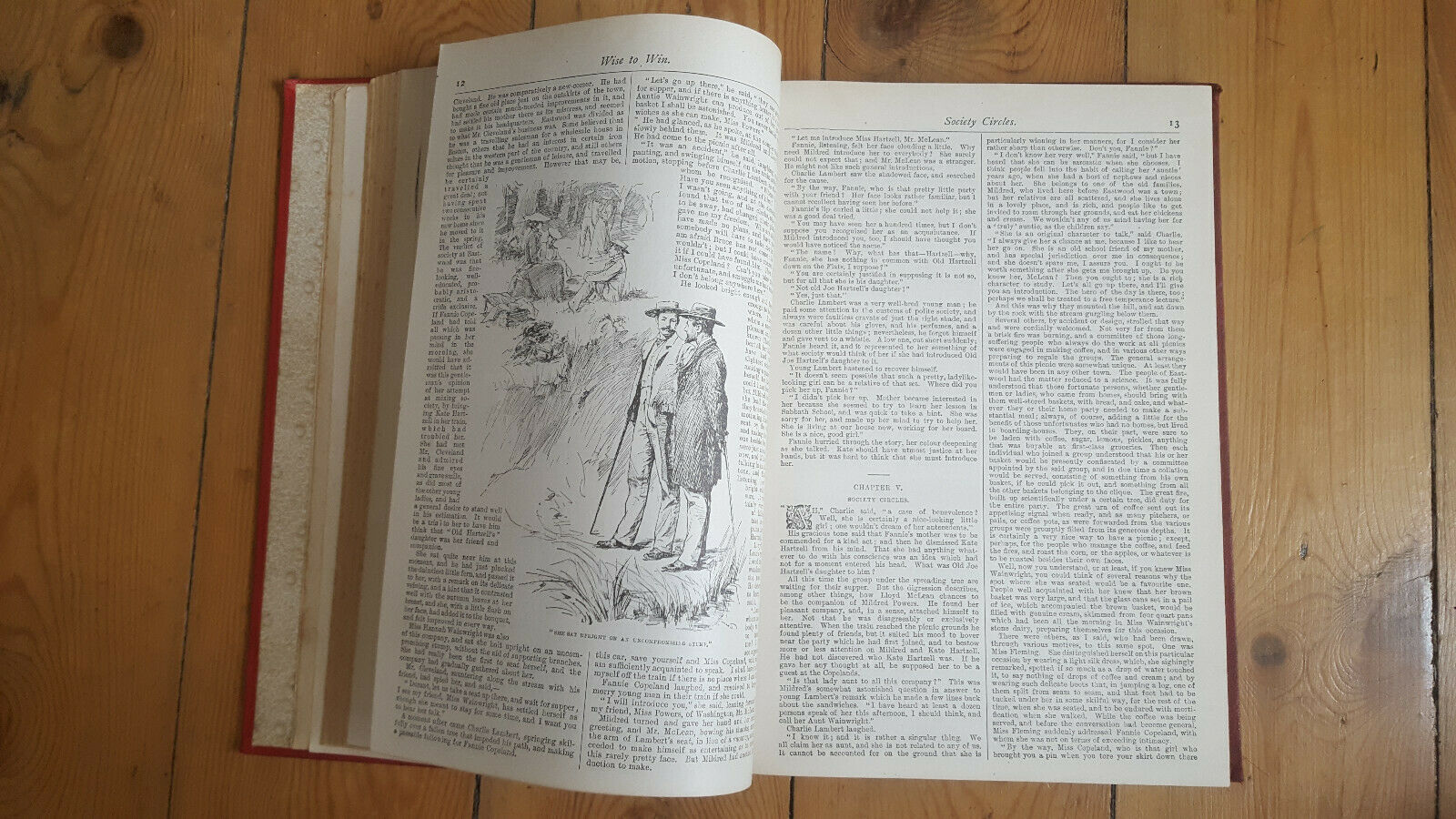
But I shook off my disappointment, remembering I still had a third story to read, Wise to Win. So I flipped to the appropriate page, took a sip of my favorite tea (to help get me back into reading mode), and dove into the story.
I hadn’t read very far before I began to think the story sounded familiar. So I did a search of all my Pansy books and found it was word-for-word the same as OneCommonplaceDay, another book I already had.
Argh, again!
OneCommonplaceDay was originally published in 1886, so I’m not sure why it was reprinted in this 1903 anthology under a different title. I’ll confess, though, that this isn’t the first time I’ve been fooled like this. Over the years I’ve bought a few Pansy books, only to find out I already owned them under a different title:
Interrupted was republished at a later date under the title, Out in the World.
EsterRied, YetSpeaking was republished as FollowingHeavenward.
And SixO’clockintheEvening was published under two different titles: Grandma’sMiracles and StoriesToldatSixO’clockintheEvening.
Luckily, I caught myself before I bought WayStation, a reprint of TwentyMinutesLate.
I’m a little sad that my latest book-buying experience didn’t end the way I wanted. Still, there are a few of silver linings:
The remaining stories in the book are ones I haven’t read before, so I’m looking forward to enjoying them.
This one-hundred-and-eighteen-year-old book is in great shape! Once I’ve read it, I plan to donate it so someone else can enjoy the stories as much as I have.
It has illustrations! I may have already shared the stories before, but the illustrations of key moments in the Pansy stories are very nice and worth sharing in future blog posts.
Will my latest book-buying experience deter me from buying other Pansy books? Absolutely not! I’ll continue to hunt for short stories and novels written by my favorite authors; and when I find them, you can bet I’ll share them on my Pansy blog.
If you haven’t visited my Isabella Alden blog yet, please follow this link. You’ll find lots of Christian books and stories to read for free. See you there!
It pains me to have to admit it, but I have come to the point in my life when I have to own up to the fact that I have too many books.
There. I said it.
Now the question is: What do I do about it?
When I stand back and look at my bookcases full of the books I love and want to read again; and books I want to keep forever; and books just waiting to be read for the first time—I honestly wonder how I can ever part with any of them.
But I have to, because there just isn’t room in my home for any new books. So I’ve come up with a plan to help me make the tough decision about which books stay and which books go.
Now that the weather is nice, I set up a little reading nook on my screened porch, with a small bookcase and a comfy chair. The window blinds help shield me from passersby, but I can adjust them to let in the right amount of reading light. And the rug on the floor brings a bit of warmth to the cold concrete floor.
On the shelves are a variety of books:
Some I have not yet read, but they’ve been sitting on the top of my To-Be-Read pile.
Some I have read, but I read them so long ago, I need to refresh my memory in order to decide if they’re still keepers.
Of course, I had to organize them by genre, then by author last name (don’t ask me why; I just had to).
And I added this little lady to keep watch over the historical romance shelf:
Once I’ve worked my way through a re-read of these books, I’ll be able to make that crucial decision of which books to keep and which to donate or share with others. Then I’ll restock the book nook shelves with the next round of books to re-read.
I tried it out yesterday with a cup of tea and had a very nice hour of reading time. This may turn out to be a very good system. What do you think?



















 Writer Jenny Berlin